Cardiac Rehabilitation That Focuses on Real Recovery
4.6
(12,550+) Google Reviews
Take the first step towards #FastestRecovery
*By submitting the form, you agree to SuVitas T&C.
Take the first step towards #FastestRecovery
*By submitting the form, you agree to SuVitas T&C.
Your Trusted Healthcare Partner
NABH Accredited
NABH is India’s official healthcare accreditation body under QCI, ensuring hospitals meet high standards for patient safety and quality care.
for Quality & Safety
QAI Accredited
Quality and Accreditation Institute (QAI), a private institution in India focused on healthcare accreditation.
for Rehabilitation Excellence
Multidisciplinary
Rehab Team
Cardiac Rehab
Cardiac Rehabilitation is the therapy used in the patients who have recently suffered from heart issues or have undergone cardiac procedures. It is a medically-supervised care program that is specially designed for working on healthy lifestyle initiatives.
The Treatment Goals We Follow
Every patient receives a specialized and patient-specific rehabilitation plan. The cardiac rehab program increases the patient’s chances of early & effective recovery and we following by very methodical approach. The patient’s medical condition will be thoroughly evaluated. Our physicians will also ensure that the patient understands the objectives of the treatment and mutually agreed-upon achievable goals are set. The objective is to help the patient make lifestyle changes that will improve his/her heart health. This reduces the risk of any further heart problems. The individualized plan that our expert multidisciplinary team establishes, helps the patient regain strength, prevents worsening of the condition and reduces the risk of any future heart problems.
Advanced Robotics & Recovery Therapy Center
Our purpose-built paralysis rehab centers reduce recovery time and improve outcomes with technology most centers in India don't have.
Delivering this level of recovery requires a
Coordinated & Multidisciplinary Approach
Our specialists don't work in parallel — they work as one team. The PM&R doctor leads, all disciplines contribute, and the patient stays at the centre of every decision.
Doctor (PM&R Specialist)
Lead your recovery plan and track progress at every stage
Physiotherapist
Mobility, strength, gait training & spasticity management from Day 1
Speech & Swallowing Therapist
Communication and swallowing disorders after stroke and brain injury
Dietician (Certified)
Daily nutrition designed around tissue repair and recovery energy needs
Nurses (24x7)
Medication management, positioning, skin integrity and patient safety
Occupational Therapist
Rebuilds daily functional independence from basic self-care to community activities
Psychologist
Emotional recovery of patient and family — motivation, adjustment, caregiver burnout
Rehabilitation Support Staff
Trained care companions who extend recovery beyond therapy into daily routine
Insurance & CashlessRehabilitation Support at HCAH SuVitas
Rehabilitation at HCAH SuVitas centers is supported by a wide network of insurance providers. As part of the HCAH network, patients can access cashless treatment and insurance support across our centers.
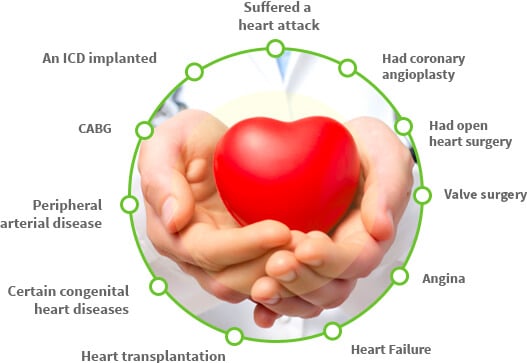
Cardiac rehabilitation is a medically supervised recovery program built for people who've had a cardiac event or procedure, and at HCAH SuVitas it covers a notably wide range — heart attack, sudden cardiac arrest, coronary artery bypass graft (CABG) surgery, angina, cardiomyopathy, congenital heart disease, peripheral arterial disease, heart failure, pacemaker implantation, and heart transplantation. The common thread is that recovery isn't just physical healing; it's about rebuilding strength, confidence, and daily function safely under guidance, rather than navigating it alone. Because the starting point looks very different for a pacemaker patient versus someone recovering from a transplant, eligibility and program intensity are determined individually by the treating cardiologist.
Structured cardiac rehab is built around a specific set of outcomes: increased strength and independence, better management of the underlying heart condition, decreased pain, prevention of future heart complications, and a reduced need for medications used to manage heart-related pain and symptoms over time. Just as important, but less talked about, are the confidence and lifestyle gains — patients are guided through initiating real lifestyle changes (diet, activity, habits) rather than just being told to make them, and many report meaningful improvement in overall wellbeing and self-confidence by the end of the program. These benefits depend on consistent participation, so results vary by how closely a patient follows the plan.
Yes — cardiac rehab is relevant after a pacemaker or other device implant, not just after major procedures like bypass surgery, though the focus differs. After bypass surgery, rehab centers heavily on physical reconditioning and wound-safe activity progression. After a pacemaker, the focus shifts more toward confidence-building, lifestyle adjustment, and learning what normal activity feels like with the device in place, alongside continued management of whatever underlying condition led to the implant. Skipping rehab after a device implant is common but not ideal, since many of the confidence and lifestyle benefits apply regardless of procedure type. A cardiologist can confirm what level of program suits the specific device and condition.
For some patients, yes — one of the documented benefits of completing structured cardiac rehab is a decreased need for medications used to manage heart-related pain and symptoms, since improved heart function, weight management, and better blood pressure control through lifestyle change can reduce how much medication is needed to keep the condition controlled. This isn't guaranteed for everyone, and it should never be pursued by stopping or reducing medication independently — any change in prescription needs to come from the treating cardiologist based on follow-up testing, not from how a patient feels after a few weeks of rehab. What rehab can reliably do is improve the conditions that make medication reduction possible to consider safely.
The program blends skilled nursing care, physiotherapy and supervised activity therapy, lifestyle education, and emotional counseling into one coordinated plan rather than treating physical and emotional recovery separately. Before any of that begins, the patient's medical condition is thoroughly evaluated, and the care team works with the patient directly to set goals that are mutually agreed and genuinely achievable — not a generic milestone list applied to every diagnosis. This matters because a goal that makes sense for someone recovering from angina looks very different from one for a heart transplant patient. Family members are also brought into this goal-setting process, since their understanding of the plan affects how well it's followed at home.
A heart attack recovery plan typically centers on rebuilding physical activity tolerance gradually while monitoring for warning signs and addressing the risk factors that led to the event in the first place. A heart transplant patient's plan, by contrast, has to account for a longer recovery window, closer medical monitoring for rejection or infection risk, and a more gradual reintroduction of activity since the body is adapting to a new organ. Both share the same underlying goals — increased strength, independence, and confidence — but the pace, intensity, and medical oversight required differ significantly. This is exactly why a personalized evaluation matters more than following a standard template for either condition.
Progress is tracked jointly by the multidisciplinary care team — nursing staff, physiotherapists, and counselors — against the specific goals agreed with the patient at the start, with consistent monitoring built into every session rather than checked only at milestones. If recovery is slower than expected, the plan is adjusted rather than the patient being pushed to keep pace with a fixed schedule; this might mean extending the physical therapy phase, revisiting lifestyle goals, or bringing in additional emotional support if confidence is the bigger barrier. Because a slower pace can sometimes signal an underlying medical issue rather than just deconditioning, any unexpected plateau should be flagged to the treating cardiologist directly.
There's no single fixed cost for cardiac rehabilitation, since pricing depends on which condition or procedure prompted it, how long the program runs, and whether care is inpatient or outpatient — a pacemaker patient's program and a bypass-surgery patient's program rarely cost the same. As part of the HCAH network, SuVitas supports cashless treatment and works with a range of insurance providers, with details available on the insurance and cashless support page. Most health insurance policies in India offer some post-cardiac-event rehabilitation coverage, but specifics vary enough by policy that it's worth confirming directly with the insurer. A consultation lets the care team give a cost estimate based on the actual condition rather than a generic figure.
Patients recovering from heart failure or a cardiac arrest do carry more risk during physical activity than someone recovering from a routine procedure, which is exactly why their rehab is more closely supervised rather than less. Skilled nursing oversight allows activity to be introduced in smaller, carefully monitored increments, with immediate response available if symptoms like breathlessness, dizziness, or irregular heartbeat appear. The bigger risk for this group is usually under-activity from fear of overexertion, which rehab is specifically designed to counter safely. Because cardiac arrest and heart failure both carry a higher baseline risk profile, the pace and intensity of any program for these patients should be set and reviewed by the treating cardiologist.
Families often notice the confidence shift before the physical one — patients who were hesitant to walk far, climb stairs, or resume normal routines after a cardiac event typically become visibly more willing to try, supported by the gradual activity progression built into the program. Alongside that, families usually see fewer complaints of pain, more consistent follow-through on lifestyle changes like diet and activity, and a noticeable drop in anxiety around everyday exertion. These shifts tend to build gradually rather than appear suddenly at the end of the program, so families shouldn't expect a single turning point. If confidence or independence isn't improving as the program progresses, that's worth raising with the care team.
Consistent Therapy And Progress Monitoring
With the priority being that the patient return to normal life, our multidisciplinary team works in a concerted and detailed manner to ensure that he/she receives effective treatment & continuity of care. We use a variety of therapies and treatments including skilled nursing care, physio and activity therapy, lifestyle education and support. In addition, the emotional counseling sessions enhance the patient’s confidence and help get back to normal life.
Recent Blogs
Give Your Loved One the Care They Deserve
Choosing the right senior care home is one of the most important decisions a family makes. At HCAH SuVitas, we make it easier — with honest conversations, transparent pricing, free assessments, and two Hyderabad centers where your loved one will genuinely feel at home. Come visit us. See the difference for yourself.